Students protest ban on gender-neutral housing

Last week, University of North Carolina at Chapel Hill students marched the mile from campus to the Board of Governors meeting site to protest the UNC System’s blanket ban, imposed by the board, on gender-neutral housing. InsideHigherEd reports that

“The new policy — which overturned the Chapel Hill Board of Trustees’ endorsement of the housing option —  was approved while students were away for the summer under the reasoning that “there are more practical ways” to make students “safe, comfortable and included,” the board chairman said.
images

“But it sparked outrage among advocates and campus officials concerned for the well-being of transgender students and others who would prefer to live outside traditionally designated pairs for college roommates.

“Among elite institutions, UNC’s move was unusual – many institutions are in fact moving in the opposite direction. There are now about 150 colleges that offer gender-neutral housing, according to a running count by Campus Pride. Granted, that’s out of more than 4,000 institutions – and it’s taken more than 20 years to get to this point.

“But for many of those campuses, whatever controversy ensued when men and women started living together has dissipated, and officials have moved on to more administrative-type policies. Last month, American University became the latest institution to cover gender reassignment surgery under its student health insurance policies.

“We’re seeing a progression. Trans students and allies have been working now for a number of years at many schools to create gender-inclusive bathrooms and gender-inclusive housing options, because those are pretty basic – to have a place to sleep and a place to pee,” said Genny Beemyn, director of the Stonewall Center at the University of Massachusetts at Amherst, the first campus to offer gender-neutral housing, back in 1992. (A recent settlement by the U.S. Education Department’s Office for Civil Rights suggests colleges would be wise to provide these options.) “They’re looking now to address other important issues, and so gender in name documentation, hormones and surgeries are coming up more and more frequently for schools that have really begun to address transgender issues.” Continue reading “Students protest ban on gender-neutral housing”


Stunning findings about addiction treatment

Intensive drug and alcohol treatment may be no more effective than a single appointment, according to a new study reported today in Journal of the American Medical Association.

WebMD reports that “Results of the year-long study are likely to disappoint those who believe treating addiction more like a chronic disease — with a systematic approach and follow-up — is the better way to go.

“We were completely surprised by the result,” said lead researcher Dr. Richard Saitz, a Boston University professor of medicine and epidemiology. “We put everything into this, and we were surprised that even doing that didn’t lead to differences compared to not doing any of it.”

“In the study of nearly 600 adult substance abusers, those receiving chronic care management got intensive medical care at a primary-care clinic plus relapse-prevention counseling and addiction and psychiatric treatment. Others in the study had one medical visit at which they received a list of addiction-treatment resources.

“After 12 months, 44 percent of those in the chronic care management group had stopped drinking or using drugs, as did 42 percent of those not receiving intensive care, the researchers said. Despite these similar findings, Saitz said he still believes chronic care management can be useful for some addictions. However, “we don’t want people to assume that it’s going to be effective when applied everywhere for every person,” he said. More work is needed to determine the best way to use chronic care management and to identify those who will benefit most from the approach, he said.

“We have to recognize that people with drug or alcohol addictions may be different and it’s not one monolithic disorder,” Saitz said. “I do think that integrated chronic care management, in the future, is going to be efficacious for people with addictions.”The report was published in the Sept. 18 issue of the Journal of the American Medical Association. Advocates of chronic care management point out that many substance abusers suffer serious health consequences but receive poor care. By addressing medical, emotional and dependence issues in a coordinated manner, patients would achieve better results, the thinking goes. One expert thinks motivation is the key to any program to treat addiction. People who are motivated are most likely to start and stick with a program or join a clinical trial, said Dr. James Garbutt, a professor of psychiatry at the University of North Carolina at Chapel Hill. “That’s an important point because that’s saying they already wanted to make some changes,” Garbutt said. “That’s a huge step in substance-abuse treatment.” Continue reading “Stunning findings about addiction treatment”

The New San Francisco

It’s not just the 22 construction cranes dotting the San Francisco skyline and 5,000 pricey condos and apartments under construction, AlterNet reports.

“Nor is it the fleet of private buses ferrying 14,000 tech workers to Silicon Valley, or the explosion of restaurants and boutiques, or rents doubling, or the spike in evictions, or home sales now averaging $1 million. imgres

What’s happening to San Francisco goes beyond the accelerating gentrification in multicultural districts like the Mission or Mayor Ed Lee minimizing affordable housing woes. The city that’s been a magnet for free spirits and immigrants and working-class people for decades seems to be losing its famous heart. Or perhaps it’s more accurate to say that its heart is being replaced by a software update.

The best encapsulation of this sea change, which is driven by a booming tech sector that’s generated 13,000 jobs since early 2012, might be this blog from former San Francisco Bay Guardian editor Tim Redmond, who begged the techie beneficiaries to stop treating the city he loves like a “rich kid’s playground.”

“When a 1990s tech-startup guy who admits he was part of the last generation of gentrification is now so fed up with the new arrival of high-paid techies that he’s ready to leave, it’s pretty serious,” he wrote in a piece titled, “The Mission ‘douchebags.’” He ended, “I know, I’m an old fart who is not rich and never will be… But if you’re lucky enough to be rich in your 20s, show some respect.”

“All economic booms bring dislocations, but what San Francisco is undergoing seems deeper because unlike past decades, when hippies arrived in the 1960s and gays came a decade later, locals were not displaced. That distinction has also been noted by longtime San Francisco Chronicle columnist Carl Nolte and by author Rebecca Solnit, another longtime resident, who recently wrote, “The problem is that we understand Silicon Valley’s values all too well, and a lot of us don’t like them.” Continue reading “The New San Francisco”

Arts and humanities grad programs are growing

Last week, the Council of Graduate Schools delivered a truly baffling piece of news, as reported in The Atlantic.

“From 2011 to 2012, it reported, the number of first-time students enrolled in arts and humanities Ph.D. programs had grown 7.7 percent. Yes, grown. Despite the slow-rolling extinction of the tenured professoriate; despite the fact that job openings haven’t even come close to recovering from the recession; despite ample doomsaying from publications like The New York Times, it seems students are still signing up at a healthy clip to pause their lives for six years in order to study English, history and the like.

“In fact, the enrollment bump was larger in the arts and humanities than almost any other broad field, with the one exception of public administration, as shown on this table from Inside Higher Ed. All of this leads to me to wonder: Why haven’t arts and humanities Ph.D. programs imploded yet? We know, thanks to the collapse of law-school applications, that undergraduate students (as a group, at least) are entirely capable of looking at the job market and making rational decisions about whether or not to pursue a graduate education. Yet in the arts and humanities, in which 43 percent of new Ph.D.’s had no job or postdoc offer by graduation in 2011, there’s no real sign of change. From 2007 to 2012, total enrollment fell by a measly 0.2 percent per year, according to the Council of Graduate Schools. Meanwhile, departments go on merrily producing more new doctorate holders than there are jobs in the academy.

“And 2012 just brought us a bumper crop of aspiring scholars. I’m going to offer a few very lightly sketched out theories in a second, but mostly, I want to hear from you, the readers. What’s keeping arts and humanities Ph.D. programs afloat? If you’re studying for a Ph.D. in the classics right now, what drove your decision making? What information did you or didn’t you have? If you’re a professor, does your department ever discuss shrinking down your incoming class size? Do students seem to have a realistic sense of their chances when they arrive for their first year of grad school?  Or do you think I have it all wrong? Is everything really fine? ”


More at: http://www.theatlantic.com/business/archive/2013/09/why-havent-humanities-phd-programs-collapsed/279733/

Beatriz da Costa at Laguna Art Museum

From the light, airy and playful feelings of the Laguna Art Museum’s “Faux Real” exhibition on the main floor, the atmosphere of “Ex·pose: Beatriz da Costa” shifts into dark, moving and intense as one descends into the museum’s dark basement, writes Seth Hawkins in Artillery:

“Da Costa’s “Dying for the Other” is a three-channel video installation dealing with the artist’s lifelong battle with cancer, with the show occurring not even 12 months after her passing—a timely and haunting exhibition of her last creation.pills

“Beatriz da Costa made work that refused genre classification—seamlessly transitioning between contemporary art, science, engineering and politics—in many cases working in collaboration with forerunning art/technology groups such as Critical Art Ensemble, Free Range Grains, GenTerra, and Preemptive Media. Born in 1974 and raised in Germany, da Costa attended Carnegie Mellon University, eventually moving on to teach in the Studio Art, Electrical Engineering and Computer Science Departments at UC, Irvine.

“While watching da Costa’s video installation, it is hard not to hear echoes of self-mutilating artist Bob Flanagan. This is by no means a masochistic performance piece, but underlying similarities can be seen. The act of creation, of continuing one’s practice in the face of grave illness or disease takes not only a special kind of artist, but also a dedicated human.

“In Dying for the Other, video clips of mice that are being used in cancer research are projected and interspersed with video segments of the artist’s life as she is going through physical/cognitive therapy after having brain surgery to remove tumors that had spread from her breast to her brain.

“Unfortunately, many of us have been touched by cancer. The battle with this disease is one of the darkest and most personal, in which the emotional toll is heaviest for those closest to the patient. In many cases the day-to-day heartbreak and immense medical traumas are hidden from the outside world, primarily internalized by the suffering person. Few want to be seen in public while fighting this battle, losing their hair, feeling constant nausea, fighting for their lives, all the while knowing that this may be an unwinnable fight. Continue reading “Beatriz da Costa at Laguna Art Museum”

Guns and freedom

The day after this week’s elections, the National Rifle Association got exactly what it wanted: a front-page New York Times story about Colorado results that supposedly send “lawmakers across the country a warning about the political risks of voting for tougher gun laws.”images-1  In These Time writes that the article, and many others like it, “came after the gun lobby mounted successful recall campaigns against two state legislators who, in the wake of mass shootings, voted for universal background checks, limits on the capacity of bullet magazines and restrictions on domestic abusers owning firearms.
“Despite the recalls being anomalously low-turnout affairs, the national media helped the gun lobby deliver a frightening message to politicians: Vote for modest gun control and face political death.
“For all that reductionism, though, there are more nuanced lessons from these elections. First and foremost, with statewide polls showing that most Coloradans support modest gun control and opposed the recall campaigns, the elections prove that in low-turnout situations, a relatively small group of pro-gun voters can still win the day.
“Additionally, with gun extremists issuing threats of violence against pro-gun-control legislators, Colorado Democrats stopped explaining why their gun legislation was so necessary. In light of that, the election results are a reminder that when politicians don’t stay on the message offensive, they quickly find themselves on the electoral defensive. This is especially the case when, as a Pew survey documented, voters who oppose gun control tend to be more motivated single-issue voters than those who support gun control. That intensity gap, of course, is the most significant story of the Colorado elections because it reveals how different people ascribe different meanings to the gun debate.   Continue reading “Guns and freedom”

Saved by the internet of things

I know the coffee’s ready because the light in the Quartz kitchen is purple, not pink. Writing in The Atlantic, Tom Fernholz states:

“The light knows the coffee is ready is because there are sensors–heat and pressure–taped to the coffee maker. This is the internet of things. It will save us all from economic ruin.

“Or at least that’s what a new estimate from innovation guru Michael Mandel says. He figures that the “internet of things”–the increasing number of machines equipped with internet-connected sensors–will expand the US economy by $600 billion and $1.4 trillion in 2025, roughly the equivalent of boosting GDP by 2% to 5% over the intervening time period. That could be the difference between so-so growth to the kind of stable growth that drives down debt and unemployment.

images

“More broadly, the argument he’s making is a reply to economists like Robert Gordon and Tyler Cowen who fear that the big gains in productivity that supported an expanding middle class and the modern welfare state won’t be replicated anytime soon. This has major social repercussions–namely a scenario known as the great stagnation. The internet, for all the ways its changed our lives, has offered its gains largely in the form of consumer surplus–free stuff on the internet you used to pay for, in short–that is great and important but not necessarily

money in your pocket.

“Today’s internet of things is limited to consumer surplus, like Quartz’s coffee pot monitor or our weather bulb.

“But the future internet of things will be a different beast, because by definition it takes the internet out of the world of abstraction and into industries–manufacturing, energy, transportation–where productivity gains would have a more tangible impact. For instance, while some trash cans are spying on you, others, made by BigBelly Solar, are keeping track of how full they are so garbage collectors can plan their routes more efficiently, saving fuel and time. The largest gains are still to come: Sticking sensors on a turbine to know exactly when it will break down and how to fix it sounds great, but actually handling all that data in a meaningful way isn’t easy.

“Another hope Mandel holds out for the technology is to make on-the-job-training easier by making machines more responsive to their users.

“Does it all sound too good to be true? Absolutely. The estimates cited are a ballpark take on figures produced by McKinsey and Co., not necessarily the gold standard of foresight. The amount of investment needed to take advantage of this technology is high, and it will be years before different systems can be integrated in ways that allow companies, individuals, and eventually governments to appreciate their benefits. But the creeping networks might be the last hope of preserving growth.”

Hangovers lessen with age

Here’s some good news for anyone who’s ever woken up fuzzy-headed and bleary-eyed after a night of heavy boozing: imgresNew research suggests that hangovers fade with age, reports WebMD:

“A large study of Danish people finds that hangover symptoms are much less likely to strike people aged 60 and older compared to their younger counterparts.

“But don’t start dreaming of post-retirement pub-crawling without pesky consequences the day after. It’s unclear why older people might suffer from fewer hangovers. They might be savvier about how to avoid them, or they might simply be more tolerant of alcohol consumption. A combination of factors could also be at play.

“Whatever the case, the research is important for more than what it says about the effects of drinking over a lifetime, said study co-author Richard Stephens, a senior lecturer in psychology at Keele University, in England. Scientists know that people who get the worst hangovers are more likely to become alcoholics, he said, possibly because drinkers who get them try the “hair-of-the-dog” approach and drink more the day after.

” If people become less likely to develop alcoholism as they age, they should have fewer hangovers too, Stephens said, “and that is what we found.”Although scientists seem to be fascinated by alcohol and its effects on the body, they haven’t spent much time studying hangovers. Never mind that they’re very common, affecting an estimated half of people when their blood alcohol level reaches 0.11 percent, which is too drunk to drive legally in the United States. For reasons that aren’t clear, an estimated 20 percent to 25 percent of people are immune to hangovers. Research suggests that smoking, on the other hand, makes hangovers worse. In the new study, researchers examined the results of surveys of nearly 52,000 people aged 18 to 94 in Denmark. Continue reading “Hangovers lessen with age”

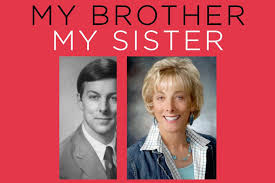
Molly Haskell’s “My Brother My Sister”

In film critic Molly Haskell’s new book, My Brother, My Sister,” begins in 2005, as John ­(Chevey) Haskell, a 59-year-old married financial adviser, tells his older sister that he has “gender dysphoria” and wants to become female.As reviewed in the New York Times, “The author doesn’t soft-pedal her reaction: “My brother . . . will be a ‘woman on the loose.’ My heart stops. The danger. The grotesqueness. An aging transsexual,” she laments. “Please tell me you’ll still be smart at money and computers, and not dumb like . . . well, like a girl?” she half-jokes.

imgres-1

“Haskell’s bewilderment is understandable. Having someone close come out as transgender can be disorienting; few realize how attached they are to a loved one’s cheek stubble or the bass timbre of his voice until those traits morph or disappear. Coping with a gender transition — which necessarily challenges binary constructions of male and female — may be even more difficult for Haskell, who in an earlier memoir, “Love and Other Infectious Diseases,” described herself as a “stoical WASP.” Unfortunately, a state of shock and confusion is not the optimal position from which to glean insights.

“And that is the state in which Haskell finds herself not only on Page 1 but two-thirds of the way through as well. Throughout, she frets. She worries that her brother, now named Ellen Hampton, will constantly be “looking over her shoulder for psychopaths.” She worries that her brother will be too attractive as a woman, or not attractive enough (“There’s nothing like a transsexual to bring out one’s latent fashion snobbery”). And she worries what other people — her friends, her housekeeper, the doorman — will think. She even pictures the reaction of their late mother, a dignified Virginia society matron: “I imagine utter devastation, shock, revulsion, a mortification that goes beyond simple shame or embarrassment. Possibly even a stroke or heart attack, or deep depression.” Continue reading “Molly Haskell’s “My Brother My Sister””

Obamacare & addiction

Obamacare’s treatment of alcoholism and other drug addiction as chronic diseases that must be covered by insurance plans could lead to as many as 40 million Americans entering rehabilitation programs, according to California Health Report, as discussed today in Think Progress.

“Government data shows that about 24 million Americans aged 12 and olderrequire treatment for a substance abuse issue — but only 11 percent of them received it at a specialty facility. These facilities charge an average of $4,000 for admission, and even outpatient facilities cost an average of $1,500 per course of treatment.

“Obamacare could help eliminate those cost barriers for people seeking treatment. “I don’t think there’s another illness that will be more affected by the Affordable Care Act,” said Dr. Thomas McLellan, former deputy director of the White House Office of National Drug Control Policy, in an interview with California Health Report.

“Substance abuse and drug addiction haven’t always been perceived as chronic illnesses. But since opiate abuse (which has steadily been on the rise in America), alcoholism, and other addictions cost about $120 billion per year in health care spending, the health law puts special emphasis on both treatment and prevention by forcing insurers to cover rehab and encouraging doctors to screen for potential addictions. Continue reading “Obamacare & addiction”

Obamacare means jobs

A new survey of chief financial officers finds that American companies expect to increasethe number of full-time employees by 1.8 percent over the next 12 months as key parts of the Affordable Care Act go into effect,

imgres

reports ThinkProgress today, “undermining conservative critics who’ve argued that the health care law would hamper business growth and expansion.

“The expected two percent growth in employment is solid, given the context of long-run shifts away from full-time employees largely because of concerns about health care reform and economic uncertainty,” John Graham, Duke Fuqua School of Business finance professor and director of the survey, said. The poll, conducted by Duke University/CFO Magazine, surveyed CFOs at 530 U.S. companies.

“The results echo broader indicators showing that companies are hiring more workers.

“Payroll figures released last month, for instance, found that job creation at small companies has almost doubled in the last six months, “reaching 82,000 jobs at firms with 49 or fewer employees in July, according to payroll processor ADP.” Small businesses are borrowing more, displaying greater confidence, and are seeing higher “sales of new franchises.”

“Though some businesses are claiming that they are hiring more part-time workers to avoid the Affordable Care Act’s employer responsibility requirements, which apply to companies with more than 50 full-time employees, that incentive is limited and research from Moody’s economist Marisa DiNatale indicates that most industries “are actually using fewer part-timers than last year.” The growth in part-time employment, which has been taking place long before the health care law, is rooted in “industries such as restaurants and hospitality that use as much as twice as many part-timers as other companies,” DiNatale concluded.

“Some employers in the Duke University survey did cite the health care law as a impediment to growth, though concerns about economic uncertainty, the belief that the stock market is overvalued and will “experience a downward correction,” and rising interest rates were also mentioned.


See: http://thinkprogress.org/health/2013/09/11/2607221/employers-obamacare-wont-stop-hiring/


Why students cheat

Academic dishonesty is not on the rise, James M. Lang argues, despite periodic media flurries suggesting otherwise in the wake of various high-profile cheating scandals. InsideHigher Ed review’s Lang’s newest book, reporting

“Data on cheating are typically self-reported, and may not be fully reliable, but there is no real reason to think that today’s college students are any less honest than their predecessors.imgres

“Still, evidence indicates that most students cheat at least once over the course of their college careers — a fact that may be most concerning, Lang writes, because it means that many classes are failing to help students really learn.

“In his new book, Cheating Lessons: Learning From Academic Dishonesty (Harvard University Press), Lang reviews research on both academic dishonesty and human learning to build a case that the most effective instructional strategies to minimize cheating are the same ones that will best help students to understand and retain the course material. When students are able to grasp the subject matter, Lang believes, they have little motivation to cheat.

“Lang — who is associate professor of English and director of the Center for Teaching and Learning at Assumption College, as well as a longtime columnist for The Chronicle of Higher Education — answered e-mailed questions about his new book, offering advice for both faculty members and administrators on how they can reduce cheating and, better yet, help students get the most out of their classes.

“Q: How would you summarize the relationship between student learning and academic honesty (or dishonesty)? What do you think might explain this relationship?

“A: Cheating is an inappropriate response to a learning environment that’s not working for the student.  Both sides of that sentence are important. It’s inappropriate, which means that we have to hold the student accountable for the dishonest action, and ensure that we maintain high standards of academic integrity.  But it’s equally true that something in that learning environment doesn’t seem to be working for that student. He might see the course as a curricular requirement that means nothing to him; he might be confused by the assignment or see it as busywork; he might see himself as not having the knowledge or skills he needs to complete the assignment.  Continue reading “Why students cheat”

Asking the right gender questions

Last week the well-respected Urban Institute published a study on technology, teen dating violence and cyberbullying, writes Dana Beyer in today’s Huffington Post Gay Voices in a piece about the study’s approach (and those used elsewhere) to asking questions about gender identity .

“The numbers were pretty horrifying, and they were worse for LGBTQ youth, both as victims and perpetrators. As I was looking through the documentation to study how the research was structured, I noticed something very interesting about the intake forms. The first question was, “What is your gender? Male. Female. Transgender/gender-queer.” The fourth question was, “Of the following, which do you primarily identify as? Heterosexual/straight. Lesbian. Gay. Bisexual. Questioning. Queer. Other.”

“This is a very rational, modern presentation, following on what we’ve learned about the independence of the two human attributes — gender identity and sexual orientation — and the primacy of gender identity over sexual orientation as a biological and social phenomenon. Putting aside polyamory, you need to know who you and you partner are before you can categorize the dyad in relationship terms.

“This is also, in its way, a classical presentation, because most official forms ask for your sex after they ask for your name. The only difference here is that “sex” is replaced by “gender,” which means the same for legal purposes. But looking a little more closely, there has been, as a result of the deliberate attempt to include trans persons, the resulting creation of a third gender. This would not be out of place in many global cultures, including early Native American/Canadian “two-spirit” (“berdache”) traditions, the Fa’afafine of Polynesia, and the hijras of the Indian subcontinent. Today Australia, New Zealand, Nepal and Germany are four nations that allow a category of indeterminate sex for birth certificates. The globalization of our understanding of trans culture has influenced our actions here in the U.S. Often we are asked how we can make medical intake documents more welcoming, to indicate a culturally competent office that would attract LGBT folks. So over the years we’ve encouraged a number of changes, including replacing “husband/wife” with “spouse,” “mother” and “father” with “parent 1” and “parent 2,” and adding a line or box to be filled in next to the two basic sexes should someone want to choose another option or explicate a bit on the choice made. Continue reading “Asking the right gender questions”

Who writes for the Times?

This past week 26 men and 10 women wrote for the New York Times. A new blog is keeping track of these numbers, as discussed below:images

“The glaring disparity between men and women writers contributing to large, influential media publications has reared its ugly head once again. But this time, we can watch along in real time.

“Launched this week, Who Writes For The New York Times? tracks the bylines on the Times’ online front page, breaks down the writers by gender and refreshes every five minutes.

Andrew Briggs, the creator of WhoWritesFor (its common designation), credits his inspiration for the site to reading a 2011 study by literary organization VIDA: Women in Literary Arts. “The Count,” as it is called, annually charts gender disparities across media giants such as The AtlanticBoston Review and Harper’s. From i’s beginnings in 2009 to its most recent 2012 report, VIDA has consistently found that men have more bylines, write more reviews and have more reviews written about their work than women do. Briggs explained his reaction to the study and his new site in an interview with The First Bound:

I think that was really the first time the idea of an imbalance in voice occurred to me. I don’t think [The New York Times has] deliberately imbalanced voices, but rather this is the kind of thing that happens when the people in charge aren’t really paying attention. Continue reading “Who writes for the Times?”

Let us now praise the non-tenured

While many higher education experts — and parents — bemoan the fact that tenured professors are a shrinking presence,now making up less than a quarter of the academic work force, a study released Monday found, surprisingly, that students in introductory classes learned more from outside instructors than from tenured or tenure-track professors, reports today’s New York Times

imgres

“Students taught by untenured faculty were more likely to take a second course in the discipline and more likely to earn a better grade in the next course than those whose first course was taught by a tenured or tenure-track instructor, the report said.

“The study, released by the National Bureau of Economic Research, is based on data from more than 15,000 students who arrived at Northwestern University from 2001 to 2008.

“According to the authors — David N. Figlio, director of Northwestern’s Institute for Policy Research; Morton O. Schapiro, the university’s president; and Kevin B. Soter, a consultant — there was “strong and consistent evidence that Northwestern faculty outside of the tenure system outperform tenure track/tenured professors in introductory undergraduate classrooms.” The differences were present across a wide variety of subject areas, the study found, and were especially pronounced for average and less-qualified students.

“Our results provide evidence that the rise of full-time designated teachers at U.S. colleges and universities may be less of a cause for alarm than some people think, and indeed, may actually be educationally beneficial,” the report said. The fact that the study included only one university — and a selective, private research university at that — left its general applicability open to question. And, skeptics point out, there are many reasons a student might take a second class in a discipline apart from the teaching skills of the previous instructor. “I’m kind of dubious,” said Anita Levy, a senior program officer at the American Association of University Professors. “I’m not surprised that introductory classes might be better taught by contingent faculty members simply because most tenured faculty more often teach advanced courses. Continue reading “Let us now praise the non-tenured”

Harsh workplace realities for transgender Americans

Transgender workers are up against alarming inequities in the American workplace today, states the Service Employees International Union (SEIU).

“Facing difficulty finding and keeping good jobs, accessing benefits and obtaining health insurance, according to a new report from the Movement Advancement Project (MAP), the National Center for Transgender Equity (NCTE), the Center for American Progress (CAP) and the Human Rights Campaign (HRC), all SEIU partner organizations.

“The study, “A Broken Bargain for Transgender Workers,”notes that transgender workers report unemployment at twice the rate of the population as a whole (14 percent versus 7 percent); nearly half of transgender people who are working are underemployed; and transgender workers are nearly four times more likely than the population as a whole to have a household income of under $10,000.

“Examples of transgender discrimination range from wage disparities and the inability to update identity documents to denial of promotions and unfair firing.

“Workplace fairness means more than freedom from harassment; it means equal access to the benefits that transgender employees need to live healthy and productive lives,” said Winnie Stachelberg, executive vice president of external affairs at CAP.

“This new report underscores the harsh reality of what it means to live and work as a transgender person in this country,” said Mara Keisling, executive director of NCTE.SEIU members at the union’s 25th Convention in Denver last year unanimously approved a resolution calling on local unions to bargain for trans-inclusive health care. Other partners supporting the report are Freedom to Work, the National Gay and Lesbian Task Force and Out and Equal Workplace Advocates.”


More at: http://www.seiu.org/2013/09/harsh-reality-of-workplaces-for-transgender-americ.php

High school and the college gender gap

Recent research has suggested various ways in which girls outperform boys in high school, making them more likely to go to college:images stronger desire to get good grades, better social skills, greater validation from academic performance.

But as Inside Higher Ed reports, “A new study suggests gender sorting — a boy’s or girl’s decision to attend one school or another – could have its own effect on the college enrollment gap.

“In a study of public school systems in Florida, researchers found that what high school a student attends is “strongly associated” with college enrollment; girls are attending high schools that have higher rates of college-going than one would expect based on the students’ test scores – and boys, vice versa.

“Over all, the high school that boys and girls attended accounts for 10.9 percent of the gender gap in college enrollment – in other words, 11 percent of the approximately 7-percentage-point nationwide gender gap in colleges is attributable to the high school attended — but the figure is significantly higher for black (15.8 percent) and Hispanic students (12.2 percent) than it is for white students (5.2 percent).

“While the paper does not make a causal link – it’s not clear whether the high schools themselves are causing the gaps – if it is the high schools having this effect on the students, one would conclude that equal gender distribution across high schools would close the college gender gap by 11 percent.

“Either girls are choosing to attend high schools that are going to advantage them by making them more likely to go to college, or girls are simply attracted to high schools whose students have higher college-going rates — even if the school does not cause this outcome — while boys are attracted to other features of high schools,” such as facilities or the characteristics of the school’s students, said Mark C. Long, co-author of the paper published in Educational Researcher and associate professor of public affairs at the University of Washington.

“The sample includes nearly 537,000 students who enrolled in a Florida public high school between 2002-6 and graduated within four years. While not every student has the ability to choose which high school to attend — say, private, traditional public, or charter — there is often some element of choice involved, either by the student selecting from a group of residential schools or a parent opting to live in a certain neighborhood.”

Read more: http://www.insidehighered.com/news/2013/09/05/how-boys-and-girls-choice-high-school-affects-college-gender-gap#ixzz2eFOz1gAH
Inside Higher Ed

Beneath the model minority image

Asian immigrants to the U.S. often bring more education and achievement with them than other groups, providing a head start that contributes to the “model minority” stereotype.

UC Irvine professor Jennifer Lee writes about the role of “hyper-selectivity”  in The Society Pages: “Recent admissions figures to the country’s most competitive magnet high schools and elite universities seem to provide evidence of “Asian American exceptionalism.” Among the students offered admission to New York City’s Stuyvesant High School this year, 9 were black, 24 Latino, 177 white, and 620 Asian. Student admissions for Bronx Science included 489 Asians, 239 whites, 25 blacks, 54 Latinos, and 3 American Indian/Alaskan Natives.

“At elite universities like Harvard, Yale, and Princeton, Asian Americans typically comprise just under one-fifth of the entering classes, while in the prestigious public universities of the University of California system, they make up 43% of the undergraduate student body at Berkeley and 55% at UC Irvine. At 13% of California’s population and 5.5% of the U.S. population, Asian Americans are an undeniable presence in higher education.

“Pundits like David Brooks, Charles Murray, and “Tiger Mother” Amy Chua have invoked the cultural values argument to explain Asian Americans’ exceptional educational outcomes. That is, their exceptional outcomes aren’t exceptional for Asian Americans: they are the result of one racial group’s hard work, discipline, grit, integrity, and living the “right way.”  While these cultural values are positive, it is worth remembering that less than a century ago, Asians were described as illiterate, undesirable, and unassimilable immigrants, full of “filth and disease.” As “marginal members of the human race,” they were denied the right to naturalize, denied the right to intermarry, and were residentially segregated in crowded ethnic enclaves. They were even, in the case of Japanese immigrants, forced into internment camps.

“So how did the status of Asian Americans change so dramatically in less than a century?

I provide a four-part argument that bridges research in immigration, race, and social psychology to identify some mechanisms that support the “Asian American exceptionalism” construct.

  1. Hyper-Selectivity: Unlike their predecessors, contemporary Asian immigrants are, on average, a highly educated, highly selected group.
  2. Positive Stereotypes and “Stereotype Promise”: Hyper-selectivity has produced positive stereotypes of Asian Americans, which, in turn, can generate “stereotype promise”—that is, being viewed through the lens of a positive stereotype can enhance performance.
  3. Self-fulfilling Prophecy: Third, the enhanced performance of Asian Americans supports the “Asian American exceptionalism” construct. Now we’ve got a self-fulfilling prophecy.
  4. Reproduction of Inequality: These processes operate to reproduce inequalities at the high end of the educational distribution. Continue reading “Beneath the model minority image”

Teen pregnancy at historic low

The rate of teenage pregnancy in the United States is at a historic low, and has dropped by more than half in the last two decades, declining across nearly all racial and ethnic groups, according to a government report released on Friday, reports Reuters

“The rate for girls ages 15-19 dropped to 29.4 births per 1,000 last year from 31.3 per 1,000 in 2011. This was less than half the 61.8 births per 1,000 teenage girls recorded in 1991.

“That is an astonishing success in terms of this particular topic of debate,” said Brady Hamilton, a statistician with the National Center for Health Statistics who led the data collection. The Center is part of the U.S. government’s Centers for Disease Control and Prevention.

“The numbers have steadily declined over the last two decades, except for a brief spike in 2006 and 2007, Hamilton said. Among racial and ethnic groups, the largest decline since 2007 was reported for Hispanic teenagers, for whom the rate dropped 39 percent to 46.3 births per 1,000 to 2012 from 2007. Last year, the rate of births for white, Black, Hispanic and Asian or Pacific Islander teenagers declined from 5 to 7 percent compared to 2011. Bill Albert, a spokesman for the National Campaign to Prevent Teen and Unplanned Pregnancy, said it was impossible to predict if the drop in teenage mothers will continue, so it is important for parents and policymakers not to mistake progress for absolute victory.

“Obviously they are making better decisions, having less sex and using more contraception,” he said. The Obama administration has invested in efforts aimed at lowering the rate of teenage pregnancies. In 2010, the U.S. Department of Health and Human Services gave $155 million in teenage pregnancy prevention grants to states, school districts and non-profit organizations.”


More at: http://www.reuters.com/article/2013/09/07/us-usa-health-teenbirths-idUSBRE98602K20130907?feedType=RSS&feedName=healthNews

Teen e-cigarette sales skyrocket

The share of middle and high school students who use e-cigarettes doubled in 2012 from the previous year, federal data show, according to the New York Times.images-1

“The rise is prompting concerns among health officials that the new devices could be creating as many health problems as they are solving.

“One in 10 high school students said they had tried an e-cigarette last year, according to a national survey by the Centers for Disease Control and Prevention, up from one in 20 in 2011. About 3 percent said they had used one in the last 30 days. In total, 1.8 million middle and high school students said they had tried e-cigarettes in 2012.

“This is really taking off among kids,” said Dr. Thomas Frieden, director of the C.D.C. E-cigarettes are battery-powered devices that deliver nicotine that is vaporized to form an aerosol mist. Producers promote them as a healthy alternative to smoking, but researchers say their health effects are not yet clear, though most acknowledge that they are less harmful than traditional cigarettes. The Food and Drug Administration does not yet regulate them, though analysts expect that the agency will start soon.

“Thomas Briant, executive director of the National Association of Tobacco Outlets, which represents 28,000 stores, said the study “raises too many unanswered questions,” for the data to be used for policy making. It was unclear, for example, whether students who tried e-cigarettes were using them regularly or only once. He pointed out that selling them to minors is now illegal in many states.

“One of the biggest concerns among health officials is the potential for e-cigarettes to become a path to smoking among young people who otherwise would not have experimented. The survey found that most students who had tried e-cigarettes had also smoked traditional cigarettes. Continue reading “Teen e-cigarette sales skyrocket”