For Ulysses

This was from the day Ulysses and I drove down to UCI to close up his office, a bittersweet moment that still stays with me. He had just retired after nearly three decades, stepping away, as it happened, at almost the exact moment the art world was finally giving him his due, with a major retrospective making its way in 2022 from Philadelphia to the Hammer. There was something very Ulysses about that timing: unhurried, unbothered by recognition that arrived on its own schedule. I can still hear Alice Coltrane’s “My Favorite Things” playing as we looked over all that history that afternoon.
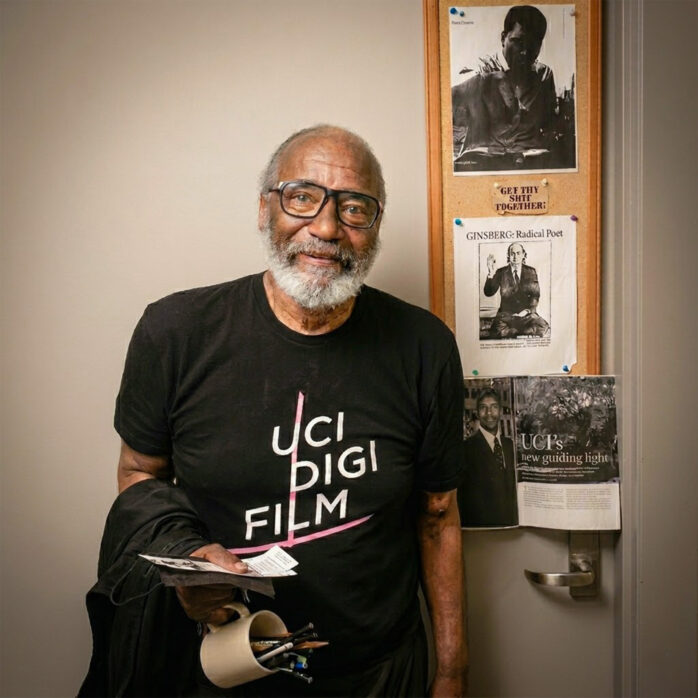
Those years at UCI were just one chapter in a remarkable career. Born in Los Angeles in 1946, Ulysses had been making video art since 1972, when the medium was brand new, picking up a Portapak when most artists hadn’t yet imagined what moving images could do in the hands of someone determined to tell different stories. Working as what he termed a “video griot,” he drew on oral storytelling traditions, structuring his work around music, poetic recitation, and dynamic performance to interrogate race, representation, and the power embedded in popular culture. 

Part of what made him singular was how early he grasped what networked media could become. During the 1980s he worked with the Electronic Café, a grassroots arts group pioneering collaborative telecommunications that connected communities through interactive video, audio, and shared screens, accomplishing this decades before Skype and Zoom. Through his conceptual art band Othervisions, he explored the relationship between spoken word and lyrical content, and as artistic director of Othervisions Studio he brought that same Afrofuturist sensibility to an interdisciplinary practice that kept evolving for fifty years. He joined UCI in 1993 and spent nearly three decades shaping generations of students who went on to cite him as a foundational influence. 

In the years that followed we got in the habit of having breakfast at Pann’s near his place every few weeks, as Ulysses became a regular part of my life. The staff adored him and always greeted him by name. I think the idyllic atmosphere of that diner was a kind of antidote to the exhausting ritual of dialysis that took up so much of his last few years. As we were sitting in Pann’s just a couple of days before he passed, he looked across the table and remarked, “This place. All these different kinds of people, together, getting along, in times like these. It’s so wonderful.” Never one to complain very much, Ulysses would often muse this way. He was one of the most relentlessly positive people I knew and at the same time one of the most brilliant. Celebrated in recent years for his visionary understanding of media and politics, Ulysses had that rare gift of intuiting novel ideas. As I was dropping him back at home that day, a different kind of mood hung in the air. Call it a premonition or something else, but I felt I had to tell Ulysses how much his friendship meant to me, both now and across the decades. Looking back now, I realize that he had been extremely frail that day. We even spoke about it briefly and he said he planned more walking. I guess I thought he would bounce back yet one more time.

“Interrupt” Journal

imagesThe term “interrupt” can have many different meanings.

Interrupt also is the title of a new online journal at UC Irvine, published through the campus Center for Excellence in Writing and Communication, featuring innovative undergraduate non-fiction writing. As Interrput‘s inaugural editorial statement puts it:

“According to the Merriam-Webster online dictionary, “interrupt” is defined as to “do or say something that causes someone to stop speaking; to cause [something] to not be even or continuous; and to change or stop the sameness or smoothness of [something].” These definitions made us cognizant of the fact that “interrupt” can engender a variety of negative connotations: it was, in fact, this realization that initially resulted in disagreement about the name of the publication.

“Originally entitled “The Word Count,” the journal’s name was changed in response to a felt need for a unifying principle that would set this journal apart from other UC Irvine publications, thus allowing for the emergence of a unique literary identity. It was decided that “Interrupt,” both as a title and concept, would contribute to this sense of innovativeness. Continue reading ““Interrupt” Journal”

The social commentary of Yoshua Okón’s “Salo Island”

Writing in OC Weekly, Dave Barton writes of the new exhibition at UC Irvine of a work by Yoshua Okón, entitled “Salo Island.”

“The Marquis de Sade was rotting away in the Bastille of pre-revolutionary France when he wrote one of his first pornographic novels, 120 Days of Sodom.beach

: “A mind-boggling litany of sexual perversion, the plot is about a foursome of wealthy French elite—a Judge, a Bishop, a Banker and a Cardinal—who kidnap a group of boys and girls, take them to an isolated castle, and then humiliate, rape and murder them. Heinous masturbatory material that it is, it’s also a grimly funny social commentary, with the degenerate Marquis pointing fingers at fellow travelers in his own social class, people who were doing things he only fantasized about.

“In 1975, Marxist Italian filmmaker Pier Paolo Pasolini used the infamous book as source material for his film Salo, or the 120 Days of Sodom, considered by many critics the most controversial movie of all time. Changing the setting from France to the last Fascist holdout of Mussolini’s Italy, Pasolini’s film doesn’t have the Marquis’ mordant sense of humor; playing things deadly serious, the bold visualization of the novel’s atrocities turns the political tract into cinema’s first torture porn.

“Shortly before the film’s release, Pasolini was brutally murdered, supposedly by a teenage male prostitute who ran over him with his own car on a desolated beach. Believed at the time to be a sex deal gone bad, the murderer (who had right-wing ties) has since recanted his confession, claiming Pasolini was assassinated for his politics, as well as his open homosexuality. Fascists apparently don’t take kindly to portrayals of themselves as ass-licking, shit-eating, child murderers. Continue reading “The social commentary of Yoshua Okón’s “Salo Island””

Pedagogical Vaudeville Revisited: Yvonne Rainer

yvonne_0Pedagogical Vaudeville Revisited: Yvonne Rainer at UC Irvine

A celebration of Yvonne Rainer at UC Irvine and beyond, Monday, April 29, 2013 | 7 – 9 PM, UC Irvine, Claire Trevor School of the Arts, Contemporary Arts Center , Experimental Media Performance Lab (xMPL)

With performances and contributions by:  Yvonne Rainer, Ben Boatright, Maura Brewer, Pat Catterson, Marcus Civin, Heather Delaney, Aaron Guerrero, Maya Gurantz, Natilee Herren, Patricia Hoffbauer, Kuan Hwa, David Kelley, Simon Leung, Monica Majoli, Lyle Massey, Lara Odell, and Sara Wookey.